
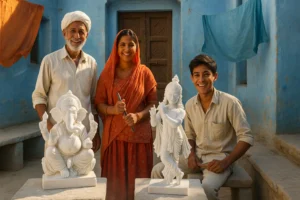
India’s marble murtis (moorti) are more than decorative pieces — they are vessels of faith, painstaking craftsmanship, and cultural memory. In the pink city of Jaipur, where stone-carving traditions have thrived for centuries, family-run exporters such as GMB Exports have become keepers of this legacy — turning raw marble into serene Lord Ganesh murti, elegant temple mandirs, and export-grade marble idols that travel the world. In this long-form feature we celebrate the artisans, the processes, and the business grit that built GMB Exports into a trusted name. For readers searching for “marble idol,” “moorti,” or “Lord Ganesh murti,” this post explains why authenticity, technique, and story still matter. GMB Exports+1
The roots: marble carving in Jaipur — a short history
Marble carving in Rajasthan stretches back centuries, shaped by temple commissions, royal patronage, and a living tradition of apprenticeships. Jaipur, Rajasthan’s craft hub, hosts communities of sculptors who treat marble like a language — each chiselled curve and polished surface speaking of training, reference models, and devotional intent. This cultural backdrop is essential: modern exporters such as GMB Exports build on apprenticeship systems, family knowledge, and local design sensibilities to deliver murtis that resonate both at home and abroad. GMB Exports
GMB Exports: a family story turned global
GMB Exports began as a family workshop in Jaipur and expanded into manufacturing and exporting marble idols, temples, and sculptures to international markets. Their website and social presence highlight a trajectory familiar to many successful craft exporters — steady local reputation, diversified product lines (from small home murtis to large temple installations), and investments in quality control and packaging for export markets. Today they promote 1,500+ artifacts and thousands of satisfied customers, reflecting both scale and a craftsman-first identity. If you’re sourcing a marble Ganesh murti or commissioned marble sculpture, their catalog and portfolio make a persuasive case for craftsmanship + export readiness. GMB Exports+1
The artisans: hands, eyes, and years of practice
What separates a good marble idol from a great one is not only the stone but the maker. Artisans at GMB — like many in Jaipur — follow time-honored steps:
-
Design & sketching: A master drafts the pose, proportions and final detailing on paper or clay maquette.
-
Block selection & roughing out: Choosing the right marble block (grain, density, veining) is crucial. Poor stone ruins even the finest carving.
-
Carving phases: Rough removal with point chisels, intermediate shaping with toothed chisels and rasps, and fine detailing with small chisels and files.
-
Sanding & polishing: Multiple grades of abrasives yield the smooth, luminous finish associated with premium marble murtis.
-
Painting & gilding (when required): Many Lord Ganesh murti and deity idols receive hand-painted details and gold-leaf accents applied by specialist artisans.
-
Quality checks & packing: For exports, delicate finishing, anti-moisture wraps, and shockproof crates are essential.
Each step takes patience and coordination. The younger generation apprenticing in these workshops spends years before being entrusted with facial features or symbolic iconography (like the modak in Ganesha’s hand). Photographs and short videos GMB shares capture those watchful hands and finishing touches — the human story behind the product. GMB Exports+1
Craftsmanship in detail: why techniques matter for moorti and marble idols
Marble is unforgiving. A misplaced stroke can ruin a murti’s expression or structural integrity. Here’s why the traditional techniques are essential:
-
Proportion & iconography: Hindu murtis (like Lord Ganesh murti) have canonical proportions — these aren’t aesthetic constraints but devotional standards. Skilled carvers internalize these rules.
-
Facial features & expression: The face is the murti’s soul. Master carvers shape eyes, lips, and tilak with extreme precision to ensure the idol’s emotive appeal.
-
Structural strength: Large idols require internal planning (balanced weight distribution, proper base) to avoid cracks or tipping.
-
Finish & tactile quality: Smooth, even polishing enhances marble’s natural translucence. The touch should feel cool and seamless, inviting devotion.
GMB Exports showcases a range of finished products — from small marble idols for pooja rooms to full mandirs — demonstrating mastery across scales. For buyers, these technical details distinguish mass-produced statues from authentic artisan-made moorti.
From local market to overseas shipping: the challenges of export
Scaling a craft business to export involves hurdles beyond carving:
-
Packaging & transit safety: Marble is heavy and brittle. Exporters must develop custom crates and vibration-damping packing to protect delicate carvings.
-
Regulatory compliance: Export documentation, customs regulations, and destination-specific labeling are part of the operations stack.
-
Design adaptation: International buyers may request custom sizes, surface treatments, or alternate finishes — requiring flexible production workflows.
-
Sustainability & ethical sourcing: Buyers increasingly ask about quarry practices and worker welfare, so transparency in sourcing and labor conditions matters.
GMB Exports’ online presence emphasizes export capability, contact points, and portfolio—evidence of having solved many operational issues that block smaller workshops from selling internationally. GMB Exports
Why authenticity and E-E-A-T matter (and how to show it)
For craft exporters selling online, being discoverable on Google requires more than good images. Google’s guidance emphasizes helpful, people-first content and signals of Experience, Expertise, Authoritativeness, and Trustworthiness (E-E-A-T). For a page about a marble Ganesh murti or a Jaipur artisan workshop, that means:
-
Publish authored content describing production steps and artisan bios (showing experience).
-
Provide product details (dimensions, weight, stone type) and high-quality photos from multiple angles.
-
Share customer reviews, certifications, export credentials and clear contact info (authority + trust).
-
Ensure fast page speeds and mobile-friendly layout so users can view images and checkouts quickly.
Implementing these signals helps sites ranking for keywords like moorti, marble idol, Lord Ganesh murti, and marble murti Jaipur.
Practical buying tips — how to choose an authentic marble murti
If you’re shopping for a Lord Ganesh murti or a marble idol:
-
Ask for material proof: Which quarry? What grade of marble?
-
Request close-up photos and a video of the idol from multiple angles.
-
Check for export-ready packaging and insurance for transit.
-
Confirm return or damage policies.
-
Look for artisan or workshop background — who made it and how long have they been carving?
These small checks protect you from low-quality replicas and ensure you receive a true artisan-made moorti.
Conclusion — honoring hands that shape devotion
Marble murtis and the artisans who create them hold a special place in cultural life and craft economies. GMB Exports stands as an example of how a family-run Jaipur workshop can preserve traditional moorti-making while meeting the demands of international customers. For buyers searching for authentic marble idols — whether a Lord Ganesh murti for a pooja room or a commissioned temple statue — the true value lies in the story, technique, and care behind each piece. When you buy a handcrafted murti, you’re not just purchasing an object; you’re supporting generations of craft and a living tradition that makes faith visible in stone. GMB Exports+1